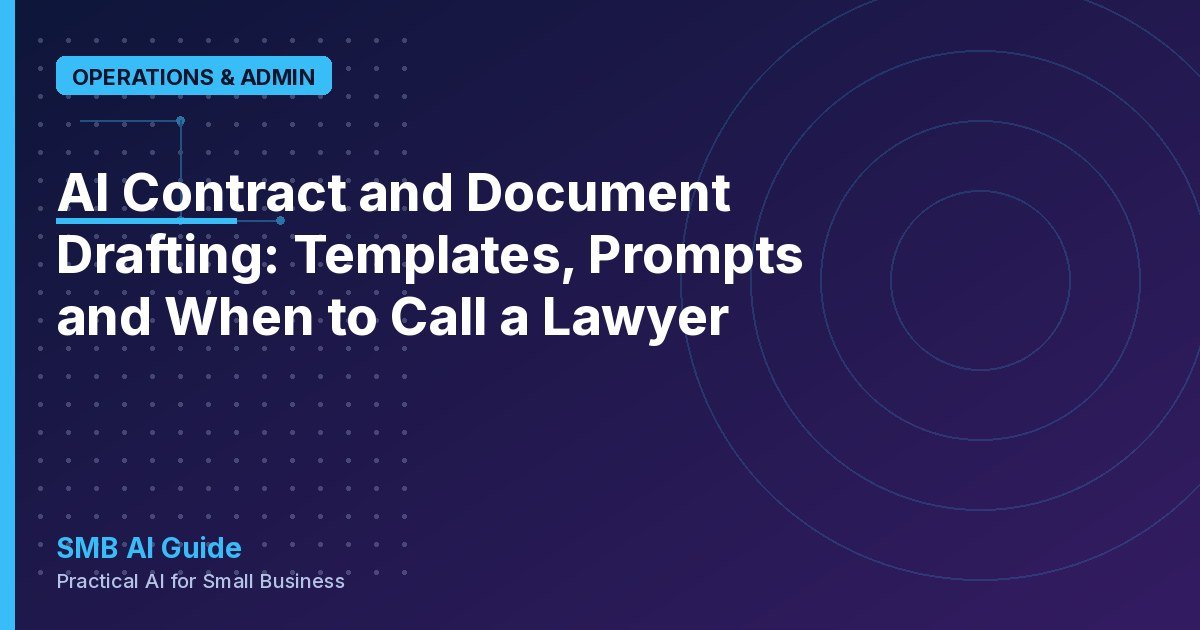
AI Contract and Document Drafting: Templates, Prompts and When to Call a Lawyer
Last updated: November 17, 2026
AI chatbots can produce a contract that looks professional in about ten seconds. That’s the opportunity, and it’s also the problem. A document can look polished and still leave out the clause that would have protected you, or include one your state won’t enforce.
So can I use ChatGPT to write a contract for my small business? For first drafts, yes. This guide shows where AI contract drafting actually saves small business owners time, gives you prompts that keep the AI honest, and lays out the situations where you should pay a lawyer. It’s general information, not legal advice. Sources were checked on November 17, 2026.
Key Takeaways
- Use AI to organize, explain and draft first versions of routine documents: proposals, scopes of work, policies, letters and a service agreement built from your own template.
- Use it to summarize contracts others send you, with clause numbers so you can check every point.
- Don’t rely on AI alone for non-competes, leases, partnership or operating agreements, employment terms or large deals. AI can be confidently wrong.
- Money math: at Clio’s $384-an-hour average for contracts work, reviewing one master template instead of every contract saves an illustrative $3,456 a year if you sign 12 contracts.
- Be skeptical of “AI lawyer” claims. The FTC’s DoNotPay order required $193,000 in monetary relief.
What AI Is Good At (and What It Isn’t)
General-purpose chatbots like ChatGPT, Claude, Gemini and Copilot are strong at language tasks: turning messy notes into clear clauses, rewriting legalese in plain English, and spotting where a document is vague or inconsistent. (See our chatbot comparison for small business.)
What they don’t reliably know:
- Your state’s current law. Contract rules vary by state and change over time.
- Your actual risk. The AI doesn’t know your customers, your insurance, or what went wrong on your last job.
- Whether a citation is real. In Mata v. Avianca (S.D.N.Y. 2023), a federal judge sanctioned lawyers who submitted a brief citing cases that didn’t exist. The court found the fake cases came from ChatGPT.
Treat AI like a fast, well-read assistant who has never been to law school and sometimes makes things up.
Documents by Risk Level
| Document | AI’s role | Lawyer review? |
|---|---|---|
| Proposals, quotes, scopes of work | Draft from your notes and pricing | Usually not needed if built on a reviewed template |
| Simple service agreement or terms | Fill in and tailor a template you already trust | Have the base template reviewed once |
| Policies (refunds, cancellations, employee AI use) | Draft and simplify | Recommended for anything customer-facing with legal effect |
| Demand letters and collection notices | Draft a calm, factual first version | Recommended before you threaten legal action |
| NDAs | Explain clauses, compare versions | Recommended for anything beyond a standard mutual NDA |
| Non-competes and employment agreements | Explain only | Yes, these are heavily state-specific |
| Leases, loans, partnership or operating agreements, buying or selling a business | Summarize and prepare questions | Yes |
A good rule: the more money, time or rights at stake, the more a lawyer’s review is worth.
The Safer Workflow: Template First, AI Second
Asking a chatbot to “write me a contract” invites it to invent terms. A safer approach:
- Start from a known template. Use one a lawyer drafted for your business, one from your trade association, or one from a reputable legal document service.
- Let AI fill in and tailor it. Give it your job details and ask it to fill the blanks without changing the protective clauses.
- Ask AI to flag gaps, not fix them. Have it list missing items as questions.
- Read every line yourself. You’re the one signing.
- Get the master template reviewed once. Paying a lawyer to review one reusable template is often cheaper than having every contract reviewed.
Prompt: tailor a template
Below is my standard service agreement template, then the details
for a new job. Fill in the job-specific blanks only: client name,
address, scope, price, payment schedule, start date. Do not change,
remove or reword any other clause. If a job detail conflicts with
the template, list it under "Conflicts to review" instead of editing.

[TEMPLATE]
[JOB DETAILS]
Prompt: plain-English scope of work
Turn these notes into a clear scope of work for a customer. Include:
what's included, what's NOT included, materials, timeline, what
happens if we find hidden problems, and what the customer must do
(access, decisions, approvals). Use plain English and short bullet
points. Don't add warranties, guarantees or legal terms I didn't
give you. Mark anything unclear with [CHECK].

[NOTES]
Clear scopes prevent many disputes. If you run a trade business, our guides for contractors and HVAC and plumbing businesses cover AI for estimates and quotes.
The numbers: can I use ChatGPT to write a contract and skip the lawyer?
You can use it to draft, but it’s usually smarter to spend your legal budget on one solid template than to skip review entirely. Clio, which publishes rate data from tens of thousands of legal professionals, puts the average U.S. lawyer rate at $362 an hour and $384 an hour for contracts work (updated October 2026). Rates differ by state: Clio lists averages of $430 in California, $440 in New York and $380 in Texas.
Two ways to budget (our assumptions, not quotes): Option A, a lawyer reviews every contract (1 hour each). Option B, a lawyer reviews your master template once (2 hours), plus 1 hour a year for updates or an unusual deal, and AI only fills in job details.
| Contracts you sign per year | A: review every contract | B: template once + AI tailoring | Difference |
|---|---|---|---|
| 4 | $1,536 | $1,152 | $384 |
| 12 | $4,608 | $1,152 | $3,456 |
| 24 | $9,216 | $1,152 | $8,064 |

How to read this.
- Option B only works for routine, repeatable contracts: the same service agreement with different names, prices and dates. Anything on the “Yes” rows of the risk table above (leases, non-competes, partnership deals) still gets its own review.
- Ask about flat fees. Clio notes that flat-fee pricing often suits routine, predictable work. A template review is a good candidate, and a flat fee caps your cost.
- Don’t send your lawyer an AI draft and ask for a fix. It can take longer to untangle than to start from the lawyer’s own template. Bring your notes and your current documents instead.
Using AI to Review Contracts Others Send You
This is one of the most useful and lowest-risk applications. When a supplier, landlord or big customer sends you a contract, AI can help you understand it before you sign.
Prompt: contract review questions
I'm a small business owner. Summarize this contract in plain English.
Then list:
1. What I'm agreeing to do, with deadlines
2. What the other party is agreeing to do
3. Payment terms, late fees and price increases
4. How either side can end it, and any automatic renewal
5. Liability limits, indemnification and insurance requirements
6. Anything unusual or one-sided I should ask about
Quote the clause number for each point. Don't give legal
conclusions. Phrase concerns as questions for my lawyer or the
other party.

[CONTRACT TEXT]
Asking for clause numbers makes it easy to check the AI’s summary against the original. Some PDF tools now include AI assistants for this. Adobe, for example, offers AI Assistant in Acrobat and says your content is “never used to train Adobe’s AI models.”
Watch what you paste
Contracts contain names, prices and sometimes personal information. Before pasting one into any AI tool, check whether it uses your inputs for training and whether a business plan offers stronger privacy controls. Our AI data privacy guide explains what to look for, and an employee AI policy helps your team follow the same rules.
When to Call a Lawyer
Call a lawyer (or at least book a consult) when:
- The deal is big relative to your business, or runs for years.
- It’s state-specific by nature. Non-competes are the classic example. California law says a contract restraining anyone “from engaging in a lawful profession, trade, or business of any kind is to that extent void,” with limited exceptions. Other states allow non-competes under varying conditions. The FTC’s nationwide non-compete rule never took effect. A federal court set it aside, the FTC dropped its appeals in September 2025, and the rule was formally removed in February 2026. State law still controls.
- You’re hiring or firing with written terms beyond a simple offer letter.
- You’re forming, buying or selling a business, or bringing in a partner.
- You’re signing a lease, loan or personal guarantee.
- A dispute has started or you’ve received a demand letter.
- The other side has a lawyer. If they’ve had their contract professionally drafted, you’re at a disadvantage reviewing it alone.
Be wary of “AI lawyer” claims
In 2025 the FTC finalized an order against DoNotPay, which had marketed itself as “the world’s first robot lawyer.” The FTC’s complaint alleged the service “was not designed to operate like a human lawyer” and that its claims were “false, misleading, or unsubstantiated.” The order requires $193,000 in monetary relief. The order also bars DoNotPay from claiming its service works like a real lawyer without evidence. Legal AI tools can be helpful, but treat bold claims with skepticism.
To find a lawyer, the American Bar Association’s Find Legal Help page offers lawyer referrals and a way to check whether someone is licensed in your state. Ask about fees for a first consultation before you book.
Electronic Signatures
Once your document is final, e-signing is fine for most business contracts. The federal ESIGN Act says a contract “may not be denied legal effect, validity, or enforceability solely because an electronic signature or electronic record was used in its formation.” There are exceptions (wills and certain other documents among them), so check if you’re unsure.
Next steps
- List the documents you use most and sort them into the risk table above.
- Pick your most-used routine contract and get the master template reviewed once, asking about a flat fee.
- Save the tailor-a-template prompt and use it only to fill in job details. Have it list conflicts instead of editing clauses.
- Run the next contract someone sends you through the review prompt, then take its questions to the other party or your lawyer.
- Check your AI tool’s training and data settings before pasting any contract, and use a business plan where you can.
- Book a consult for anything on the “Yes” rows: leases, loans, non-competes, partnership deals or an active dispute.
FAQ
Can ChatGPT write a legally binding contract?
A contract’s validity depends on what it says and how it’s agreed to, not on who typed it. But AI may leave out important protections or include terms your state won’t enforce. Use AI for drafts and summaries, and have important documents reviewed.
Is it safe to upload contracts to AI tools?
It depends on the tool and plan. Check whether your inputs are used for training and what privacy controls you have. Remove sensitive personal information where you can, and prefer business plans with stronger data protections.
What’s the best way to use AI for contracts without a lawyer?
Start from a template you trust, have AI fill in only the job-specific details, and ask it to flag gaps as questions. Getting one master template reviewed by a lawyer is a cost-effective middle ground.
Can AI review a contract before I sign it?
Yes, as a first pass. Ask for a plain-English summary with clause numbers, and a list of questions about renewal, liability, payment and termination. Verify each point against the original. For high-stakes contracts, get professional review.
Are AI-drafted non-competes enforceable?
That depends on your state, not the drafting tool. California voids most employee non-competes, and other states have their own rules. Since the FTC’s federal rule was removed, state law controls, so this is a document to have a lawyer handle.
How much does a lawyer charge to review a contract?
It varies by state, practice area and how complex the document is. Clio’s October 2026 data puts the U.S. average at $362 an hour for lawyers overall and $384 for contracts work. Ask for a flat fee on a routine template review.
Sources and methodology
How we gathered this. Legal points come from primary sources: the Mata v. Avianca sanctions order, the FTC’s DoNotPay consent-order analysis, California BPC §16600, the Federal Register notice removing the FTC non-compete rule (February 12, 2026) and the ESIGN Act (15 U.S.C. §7001). Lawyer rates come from Clio’s rate comparison page (updated October 2026), which draws on aggregated, anonymized data from its users, so it is not a census of all lawyers. Adobe’s training statement comes from its Acrobat AI Assistant page. The review-cost table is our arithmetic with labeled hour assumptions, not quotes. Pages were checked November 17, 2026. This is general information, not legal advice; the editor researches official sources and is not a lawyer. No affiliate links.
Sources
- Mata v. Avianca, Inc., Opinion and Order on Sanctions (S.D.N.Y. June 22, 2023), via Justia: https://law.justia.com/cases/federal/district-courts/new-york/nysdce/1:2022cv01461/575368/54/
- FTC, “Analysis of Proposed Consent Order to Aid Public Comment,” In the Matter of DoNotPay, Inc.: https://search.ftc.gov/system/files/ftc_gov/pdf/DoNotPayInc-APCOAPC.pdf
- The Verge, “DoNotPay must pay $193,000 for ‘AI Lawyer’ claims” (Feb. 11, 2025): https://www.theverge.com/news/610401/donotpay-cant-make-false-ai-lawyer-claims-says-ftc
- California Business and Professions Code § 16600: https://leginfo.legislature.ca.gov/faces/codes_displaySection.xhtml?lawCode=BPC§ionNum=16600
- Federal Register, “Revision of the Negative Option Rule, Withdrawal of the CARS Rule, Removal of the Non-Compete Rule…” (Feb. 12, 2026): https://www.federalregister.gov/documents/2026/02/12/2026-02866/revision-of-the-negative-option-rule-withdrawal-of-the-cars-rule-removal-of-the-non-compete-rule-to
- 15 U.S. Code § 7001 (ESIGN Act), via Cornell LII: https://www.law.cornell.edu/uscode/text/15/7001
- Adobe, Acrobat AI Assistant: https://www.adobe.com/acrobat/generative-ai-pdf.html
- American Bar Association, Find Legal Help: https://www.americanbar.org/groups/legal_services/flh-home/
- Clio – Compare average lawyer hourly rate by state and practice area (updated Oct. 2026): https://www.clio.com/resources/legal-trends/compare-lawyer-rates/