
How Can Auto Repair Shops Use ChatGPT? Estimates, Customer Texts and the Jobs AI Should Never Touch
Last updated: November 17, 2026
How can auto repair shops use ChatGPT without risking a comeback or a complaint? Use it as a typist, not a technician. An independent shop’s day is full before anyone opens a laptop: cars on the lift, parts on back-order, a customer in the waiting room who wants a plain-English explanation, and a phone that won’t stop. AI won’t diagnose a misfire from a blurry photo, and it shouldn’t set your labor rates. Used carefully, it can turn a technician’s bay notes into a readable estimate, a parts email or a status text, so the people who fix cars spend less time typing.
This guide gives you copy-ready prompts, government data on how few shops use AI so far, and a calculator to check whether it’s worth your time. It’s general information, not mechanical, legal or accounting advice. We haven’t tested shop-management software hands-on. Confirm repair procedures in the service information and TSBs, never in a chatbot.
Key Takeaways
- Most shops haven’t started yet. In the Census Bureau’s survey collected Oct 19–Nov 1, 2026, 15.7% of businesses in “other services,” the sector that includes auto repair, used AI in the prior two weeks, against 24.2% of all U.S. businesses.
- Shops are small, so time is the constraint. Census counts 169,572 auto repair and maintenance establishments with employees; 83.6% have fewer than 10 people.
- Best uses: turning technician notes into estimate narratives, customer texts and emails, parts follow-ups, declined-work reminders and review replies.
- Never let AI invent a diagnosis, part number, labor time, torque value, price or authorization.
- Do the math: saving 3 minutes on each of 12 repair orders a day is worth about $317 a month at the BLS median technician wage ($24.34/hour), against roughly $20–$25 a month for a business AI seat.
The numbers: where independent shops stand on AI
We pulled two federal data sets to put the hype in context.
1. Adoption is below average. The Census Bureau’s Business Trends and Outlook Survey (BTOS) asks businesses every two weeks whether they used AI in any business function. In the latest release (collected October 19–November 1, 2026), 24.2% of all businesses said yes. In the “other services” sector, which includes auto repair along with salons, laundries and other local services, it was 15.7%. Census doesn’t publish a figure for auto repair alone, so treat the sector number as a rough proxy.
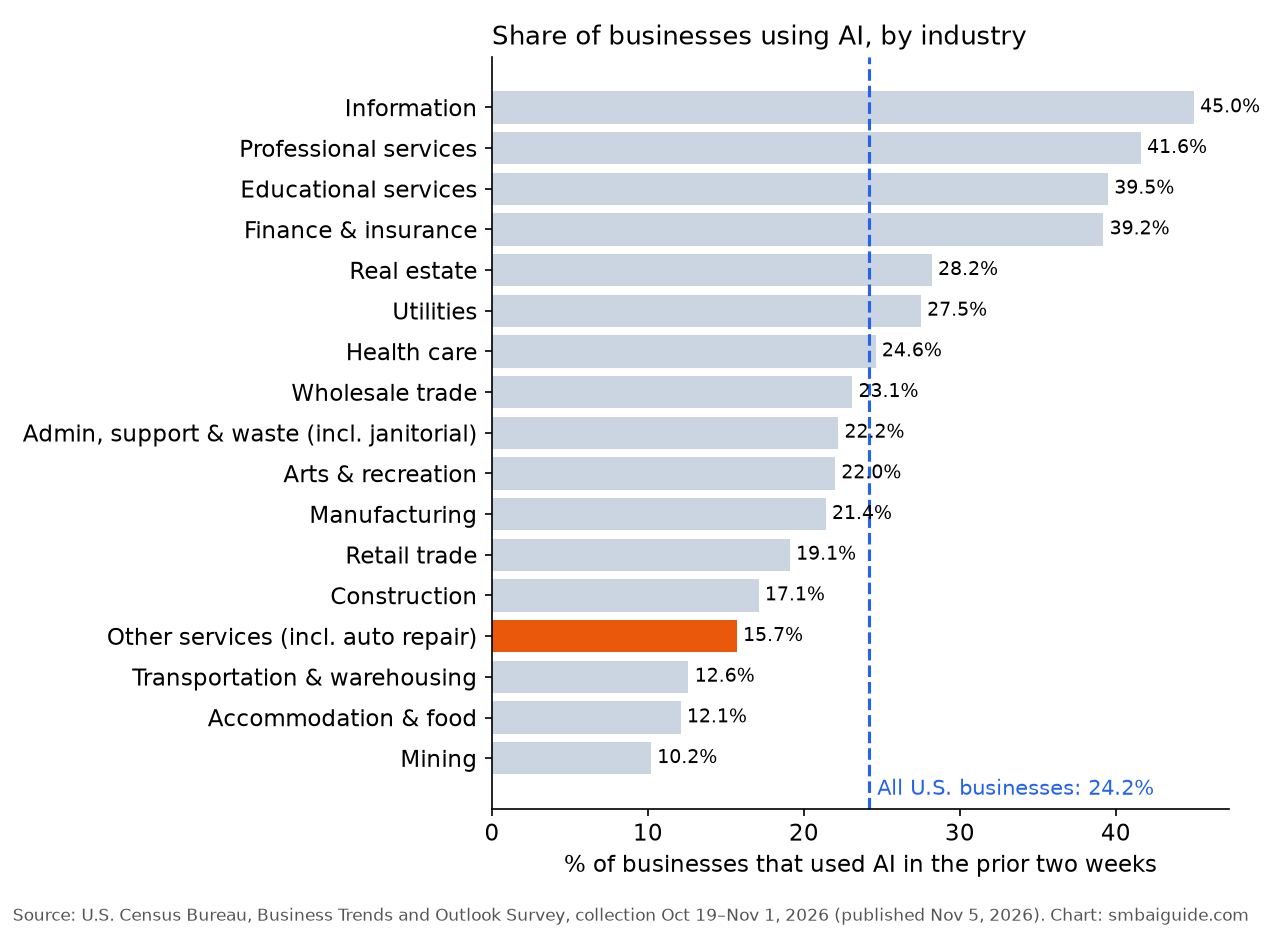 Share of businesses using AI in the prior two weeks, by sector. Source: U.S. Census Bureau BTOS, collection Oct 19–Nov 1, 2026.
2. Shops are small. Census County Business Patterns (2023 data) counts 169,572 U.S. establishments in automotive repair and maintenance (NAICS 8111), with 992,292 employees. That’s an average of 5.9 people per location.
| Shop size (employees) | Establishments | Share of all shops | Cumulative share |
|---|---|---|---|
| 1–4 | 102,158 | 60.2% | 60.2% |
| 5–9 | 39,562 | 23.3% | 83.6% |
| 10–19 | 20,641 | 12.2% | 95.7% |
| 20 or more | 7,211 | 4.3% | 100% |
Source: U.S. Census Bureau, County Business Patterns 2023, NAICS 8111. Counts only establishments with paid employees. Our calculation of shares.
What this means for you: in a five-person shop, the service writer is often also the parts runner, cashier and phone. Any tool has to save time on day one and be quick to check. That favors simple writing help over big “AI platforms.”
Where AI earns its keep, and where it doesn’t
Worth trying:
- Turning messy bay notes into a structured estimate the service writer can edit
- Explaining a recommended repair in plain language
- Drafting a parts-order email or a “waiting on parts” update
- Declined-work follow-ups that mention the specific vehicle and recommendation
- Replying to Google reviews without sounding canned
- Summarizing a long technical bulletin after you have the official document open
Not a job for a chatbot:
- Final diagnosis
- Torque values, airbag procedures or anything safety-critical you haven’t confirmed in the manual
- “You need a new transmission” because similar cars often do
- Prices the shop hasn’t approved
- Invoices, authorizations or inspection results your state requires in a particular form
If you already use shop-management software, look there first. Many platforms now advertise built-in writing features, which keeps customer data on the work order instead of in a second app. If you still want a general assistant, use a business plan with the privacy settings you want. Our ChatGPT vs. Gemini vs. Claude vs. Copilot comparison compares those plans.
Workflow 1: From technician notes to an estimate draft
After the inspection, the technician already knows what they saw. The bottleneck is writing it up so the customer can authorize the work.
You are drafting an estimate worksheet for an auto repair service writer.
Vehicle: [year, make, model, engine] (do not add a VIN unless I include one)
Mileage: [ ]
Technician notes: [paste rough notes]
I will fill in prices. Do not invent part prices, part numbers or labor hours.

Output:
1. Recommended jobs, each with: complaint, cause (only if clearly in the notes),
   correction, and parts by description (no made-up part numbers).
2. Items that need a follow-up test or a customer decision, listed separately.
3. A plain-English customer explanation (120 words), no scare language,
   no claims that are not in the notes.
4. A checklist of what I must verify in the catalog and labor guide.
Hypothetical notes, not a real job: “2016 Camry 4-cyl, 118k, front brakes 2mm, rotors grooved, RF caliper slides sticking, rears 6mm ok, customer mentioned hesitation, no codes, needs test drive after brakes.”
A good draft lists a front brake job with caliper service on the right front, marks the hesitation as needs a test drive before any recommendation, and writes a calm paragraph for the customer. A bad draft invents a transmission replacement, a recall you haven’t checked, or “8 hours” the labor guide doesn’t support. The service writer’s job is to catch the bad draft in two minutes.
Workflow 2: Customer updates and authorization texts
Rewrite this update as a short SMS and a slightly longer email.
Tone: respectful, clear, no slang, no pressure.
Do not change any prices, times or mechanical facts I listed.
If I did not give a price, leave a placeholder.
Notes: [ ]
Get documented authorization in whatever form your state and your shop require before extra work starts. AI can draft the message; it can’t be the authorization. Keep recommended work visibly separate from authorized work. If the customer approved only the brakes, the draft must not “helpfully” add a fluid service as if it were approved.
Workflow 3: Parts delays and declined work
When a part is delayed, a two-sentence update prevents a one-star review. Draft it, insert the real ETA from the supplier, and send it from your shop system so the history stays on the work order.
For declined work, have AI write a short, specific reminder (“At your last visit we noted the rear brakes at 3mm…”). Send it from your system with an easy opt-out, and follow texting-consent rules.
Don’t ask a chatbot to “find the cheapest aftermarket part” and then order it. Fitment errors are expensive. Return the AI’s list to a human catalog search.
Tool: is it worth it for your shop? A 5-minute calculator
Fill in your own numbers. Our example uses labeled assumptions.
| Line | Your shop | Example |
|---|---|---|
| A. Repair orders per day that need a written customer explanation | ___ | 12 (assumption) |
| B. Minutes per explanation today | ___ | 6 (assumption) |
| C. Minutes with an AI draft, including checking it | ___ | 3 (assumption) |
| D. Minutes saved per day = A × (B − C) | ___ | 36 |
| E. Hours saved per month = D × 21.7 workdays ÷ 60 | ___ | 13.0 |
| F. Hourly cost of the person writing | ___ | $24.34 (BLS median, automotive service technicians, May 2025) |
| G. Monthly value = E × F | ___ | ≈ $317 |
| H. Tool cost | ___ | $20–$25/seat for a business AI plan |
If AI saves only one minute per repair order, the same shop saves about 4.3 hours, roughly $106 a month: still positive, but slim once you count setup. If the checking step takes as long as writing from scratch, the value is zero. Time it for two weeks before you decide. Our AI cost and ROI guide explains the method.
The BLS wage is for technicians, used here as a stand-in. Use your service writer’s actual pay plus payroll costs if you know it.
Written estimates, warranties and advertising
Many states have their own rules on written estimates, authorization before extra work, storage fees and returning replaced parts on request. Those rules don’t relax because a chatbot drafted the paperwork. Use your existing estimate form and let AI fill only the narrative fields after a person has entered labor times and prices.
On warranties, don’t let a draft announce that a repair “voids the manufacturer’s warranty” or “doesn’t affect the warranty” unless that’s a position you stand behind. The federal Magnuson-Moss Warranty Act rules are in 16 CFR Part 700. If you offer a shop warranty, quote your written terms. Don’t let a model invent a 3-year/36,000-mile promise you don’t offer.
Ads still have to be true even if a tool wrote the Facebook post. Explain the conditions on “free loaner,” “lifetime brake pads” or “same-day service,” and never publish a testimonial from a customer who doesn’t exist. See AI images and ads.
What stays in the shop system
| Task | AI may draft? | A person must… |
|---|---|---|
| Estimate narrative and customer explanation | Yes | Verify diagnosis, parts, labor and prices |
| Status text or email | Yes | Insert the real ETA; get authorization if work changes |
| Review reply | Yes | Edit in the shop’s voice; no fake reviews |
| Final diagnosis, torque or airbag procedure | No | Use the manual, TSBs and equipment |
| State inspection result | No | Follow official inspection rules |
| Insurance or fleet claim file | Not in a consumer chatbot | Keep it in the systems meant for it |
| Labor-guide hours and part numbers | No inventing | Look them up, then type them in |
Pasting a customer’s name, phone and VIN into a personal ChatGPT account is how a convenience habit becomes a data problem. See our data-privacy guide and the employee AI policy template.
Next steps
- Pick one workflow this week: estimate narratives or status texts.
- Paste the prompt above into a business AI plan or your shop software’s writing tool, and test it on five past repair orders with the names removed.
- Time each draft, including checking, and fill in the calculator.
- Write a one-line rule for staff: “AI drafts words; people supply diagnosis, parts, hours and prices.” Our team training plan shows how to roll it out.
- After two weeks, keep it, shrink it to the task that worked, or drop it.
Frequently asked questions
Can ChatGPT diagnose a car?
No. It can suggest areas to check from a code description, but it can’t hear the noise, read live data or see the car. Diagnosis stays with a qualified technician and the right equipment.
Is it safe to paste a VIN into ChatGPT?
Avoid putting unnecessary customer or vehicle identifiers into a consumer chatbot. Use your shop software, or a business AI plan whose terms say it doesn’t train on your data, and leave names and phone numbers out.
Which shop-management software has the best AI?
We don’t rank vendors or publish test scores. Compare current features, data terms and prices on vendor sites, and ask whether the AI is just a writing assistant or actually uses your shop’s history.
Will AI speed up estimates enough to pay for itself?
Only if checking a draft is faster than writing from scratch. Use the calculator above with your own times. In our example, three minutes saved on 12 repair orders a day is worth about $317 a month in labor.
Can AI write our warranty or inspection forms?
No. Use your existing legal forms and state-required layouts. AI can explain a completed estimate in plain language after a person has filled in the real terms.
Should we tell customers we use AI to draft updates?
You don’t need a disclaimer on every text. You do need a person to check the mechanical facts and prices. If a customer asks, say a person reviewed the message before it went out.
Sources and methodology
How we gathered the data: AI adoption figures come from the Census Bureau’s Business Trends and Outlook Survey sector file (question: business used AI in any function in the last two weeks), collection period October 19–November 1, 2026, published November 5, 2026, downloaded November 17, 2026. Shop counts and size classes come from County Business Patterns 2023 (NAICS 8111, all legal forms); we computed the shares and averages. The wage figure is the May 2025 national median hourly wage for automotive service technicians and mechanics (SOC 49-3023) from the BLS OEWS program. The calculator’s repair-order counts and minutes are labeled assumptions, not measurements. We haven’t tested shop software hands-on and have no affiliate links.
- U.S. Census Bureau, Business Trends and Outlook Survey data downloads: https://www.census.gov/hfp/btos/data_downloads
- U.S. Census Bureau, County Business Patterns datasets (2023): https://www.census.gov/programs-surveys/cbp/data/datasets.html
- U.S. Bureau of Labor Statistics, OEWS May 2025 tables: https://www.bls.gov/oes/tables.htm
- eCFR, 16 CFR Part 700 (Magnuson-Moss Warranty Act interpretations): https://www.ecfr.gov/current/title-16/chapter-I/subchapter-G/part-700
General information only. This is not mechanical, legal, tax or IT-security advice. Confirm procedures in official service information, and confirm software prices and data terms with the vendor. See our Disclaimer.