The Biggest AI Mistakes Small Business Owners Make (8 Real Cases and What They Cost)
Last updated: November 17, 2026
The biggest AI mistakes small business owners make aren’t exotic. They’re trusting an answer without checking it, letting a chatbot make promises, automating decisions about people, and overselling what “AI-powered” means. We know because each one has already happened in public, with a tribunal, court or regulator putting a dollar figure on it.
An airline that said its chatbot was responsible for its own words. Lawyers fined for citing court cases that never existed. A city chatbot telling business owners they could take workers’ tips. Most of these involve big organizations, but the lessons apply directly to a five-person shop using ChatGPT or a website chatbot. Below are the mistakes, the real cases behind them, what each one cost, and a simple guardrail for each.
Key Takeaways
- AI makes things up (“hallucinates”). Federal judges have sanctioned lawyers $3,000 to $5,000 for filing AI-invented citations. Verify any fact, law or number before you rely on it.
- You’re responsible for what your chatbot says. A Canadian tribunal ordered Air Canada to pay C$812.02 after its chatbot gave wrong bereavement-fare information.
- The costliest mistakes in our case table involve people decisions and marketing claims, not chatbot slips: $365,000 (automated age screening) and $193,000 (“robot lawyer” claims).
- Every case had a cheap fix: a human check, a narrower chatbot, or an honest claim.
- Use our 8-question self-audit below to find your own biggest risk in five minutes.
The 8 Mistakes, With the Real Cases
Mistake 1: Trusting AI answers without checking
AI chatbots produce fluent, confident text, including details that are false. The legal profession has learned this the hard way.
Mata v. Avianca (2023). In federal court in New York, lawyers submitted “non-existent judicial opinions with fake quotes and citations created by the artificial intelligence tool ChatGPT,” then “continued to stand by the fake opinions after judicial orders called their existence into question.” Judge P. Kevin Castel imposed a $5,000 penalty and ordered the lawyers to send letters to the judges falsely named as authors of the fake opinions (Opinion and Order on Sanctions). Notably, the judge wrote that “there is nothing inherently improper about using a reliable artificial intelligence tool for assistance.” The problem was failing to check.
Coomer v. Lindell (2025). Two years later, a federal judge in Colorado imposed $3,000 sanctions on each of two attorneys (one jointly with his law firm) after a filing contained “nearly thirty defective citations” (U.S. District Court order). The problem hasn’t gone away.
NYC’s MyCity chatbot (2024). New York City launched an AI chatbot to help business owners. The Markup found it told business owners, among other things, that they could take a cut of workers’ tips and that a restaurant could go cash-free. The Markup reported both answers were wrong; a 2020 city law requires businesses to accept cash. It also noted the bot didn’t give the same answer every time (The Markup). The city kept it online with more prominent disclaimers (The Markup).
Guardrail: treat AI output on laws, taxes, regulations, prices and statistics as a lead, not an answer. Check the original source (the statute, the agency page, the vendor’s pricing page). Ask the AI to cite sources, then open each one. If it can’t point to a real source, don’t use the claim.
Mistake 2: Thinking your chatbot isn’t “you”
Moffatt v. Air Canada (2024). A customer asked Air Canada’s website chatbot about bereavement fares. The chatbot suggested the customer could book now and apply for the reduced fare afterward, within 90 days of the ticket being issued. Air Canada’s own “Bereavement travel” page said the policy didn’t apply after travel was completed, and an Air Canada representative later admitted the chatbot had used “misleading words.” In the dispute, Air Canada argued it couldn’t be held liable for information provided by the chatbot.
British Columbia’s Civil Resolution Tribunal (a small-claims tribunal) called that “a remarkable submission” and wrote: “It should be obvious to Air Canada that it is responsible for all the information on its website. It makes no difference whether the information comes from a static page or a chatbot.” The customer had paid C$1,630.36 for the two flights; the tribunal found the bereavement fare would have been C$979.48. It found negligent misrepresentation and ordered Air Canada to pay C$812.02 in total: C$650.88 in damages plus C$36.14 in pre-judgment interest and C$125 in tribunal fees (Moffatt v. Air Canada, 2024 BCCRT 149).
It’s a Canadian small-claims decision, so it doesn’t bind U.S. courts. But the reasoning is a practical warning: customers will reasonably rely on what your chatbot tells them.
Guardrail:
- Limit your chatbot or AI receptionist to topics you’ve written answers for (hours, services, booking).
- Route refunds, warranties, pricing exceptions and legal questions to a human.
- Make sure the bot’s answers match your written policies, and re-test after every policy change.
- Read a sample of chat logs every week.
Mistake 3: Over-automating decisions about people
EEOC v. iTutorGroup (2023). According to the EEOC, a tutoring company programmed its application software to automatically reject female applicants aged 55 or older and male applicants aged 60 or older, rejecting more than 200 qualified U.S. applicants. The company agreed to pay $365,000 and adopt anti-discrimination policies and training (EEOC).
The lesson isn’t “never use software in hiring.” It’s that automated filters can make illegal decisions at scale, and the employer is responsible.
Guardrail: a human reviews every rejection that software recommends, at least until you’ve audited the results. Never screen on age, birth dates, or other protected characteristics. The same rule applies to automated decisions about tenants, credit or pricing. Our real estate guide covers fair-housing risks.
Mistake 4: Overclaiming what your AI does
FTC and DoNotPay (2024–2025). DoNotPay marketed itself as “the world’s first robot lawyer.” According to the FTC’s complaint summary, the company’s claims were “false, misleading, or unsubstantiated.” The FTC also alleged that DoNotPay falsely claimed its service could analyze a consumer’s small business website for federal and state law violations. The order required $193,000 in monetary relief and bars claims that the service performs like a human lawyer or other professional without evidence (Federal Register). The FTC finalized the order in February 2025 (The Verge).
Guardrail: if you advertise “AI-powered” anything, such as estimates, diagnostics or design, make sure you can back up every claim about accuracy, savings or expertise. “Uses AI to draft a first estimate, reviewed by our team” is safer than “AI-perfect quotes.”
Mistake 5: Faking reviews or testimonials with AI
The FTC’s rule on consumer reviews makes it an unfair or deceptive practice for a business to write, create or sell a consumer review or testimonial that materially misrepresents that the reviewer exists or actually used the product or service (16 CFR 465). AI makes fake reviews easy to generate. Don’t. Use AI to help you respond to real reviews instead; see our Google review response guide.
Mistake 6: Pasting sensitive data into the wrong tool
In 2023, Samsung temporarily restricted generative AI on company devices after engineers uploaded sensitive internal source code to ChatGPT (TechCrunch). For a small business, the equivalent is a staffer pasting a customer list, Social Security numbers or a client’s tax return into a free chatbot.
Guardrail: use business plans with training turned off, and keep a written “never paste” list. See our AI data privacy guide and AI policy template.
Mistake 7: Assuming you own everything AI creates
The U.S. Copyright Office says that when “an AI technology determines the expressive elements of its output, the generated material is not the product of human authorship” and “is not protected by copyright.” Works can still be protected when a human selects, arranges or modifies AI material creatively (Federal Register, March 2023).
Guardrail: for logos, signature designs or anything you need to protect, involve a human designer and talk to an IP attorney.
Mistake 8: Automating outreach without consent
The FCC confirmed in 2024 that AI-generated voices count as “artificial” voices under the Telephone Consumer Protection Act, which generally means you need the called person’s prior express consent (FCC). Automated texts have consent rules too. Before running outbound AI calls or text campaigns, get legal advice.
What These Mistakes Actually Cost: Our Case Comparison
We pulled the dollar amount from each primary record (court orders, the tribunal decision, the EEOC press release and the FTC’s Federal Register notice) and lined them up next to the guardrail that would most likely have prevented the problem. Amounts are what was ordered or agreed, not the total cost; legal fees, staff time and reputational damage aren’t included.
| Case | Mistake type | Ordered payment / settlement | Cheapest guardrail |
|---|---|---|---|
| Moffatt v. Air Canada (2024) | Chatbot gave wrong policy | C$812.02 | Route refund and fare-policy questions to a human or the policy page |
| Mata v. Avianca (2023) | Unchecked AI citations | $5,000 (joint) | Open and read every source before filing |
| Coomer v. Lindell (2025) | Unchecked AI citations | $6,000 ($3,000 x 2) | Same: verify citations |
| FTC order, DoNotPay (2025) | Overclaiming AI ability | $193,000 | Only make claims you can prove |
| EEOC v. iTutorGroup (2023) | Automated screening of people | $365,000 | Human review of every automated rejection |
| NYC MyCity chatbot (2024) | Chatbot gave unlawful advice | No payment reported | Limit scope; test against real questions |
| Samsung (2023) | Sensitive data in a public chatbot | No payment reported | “Never paste” list; business plans |
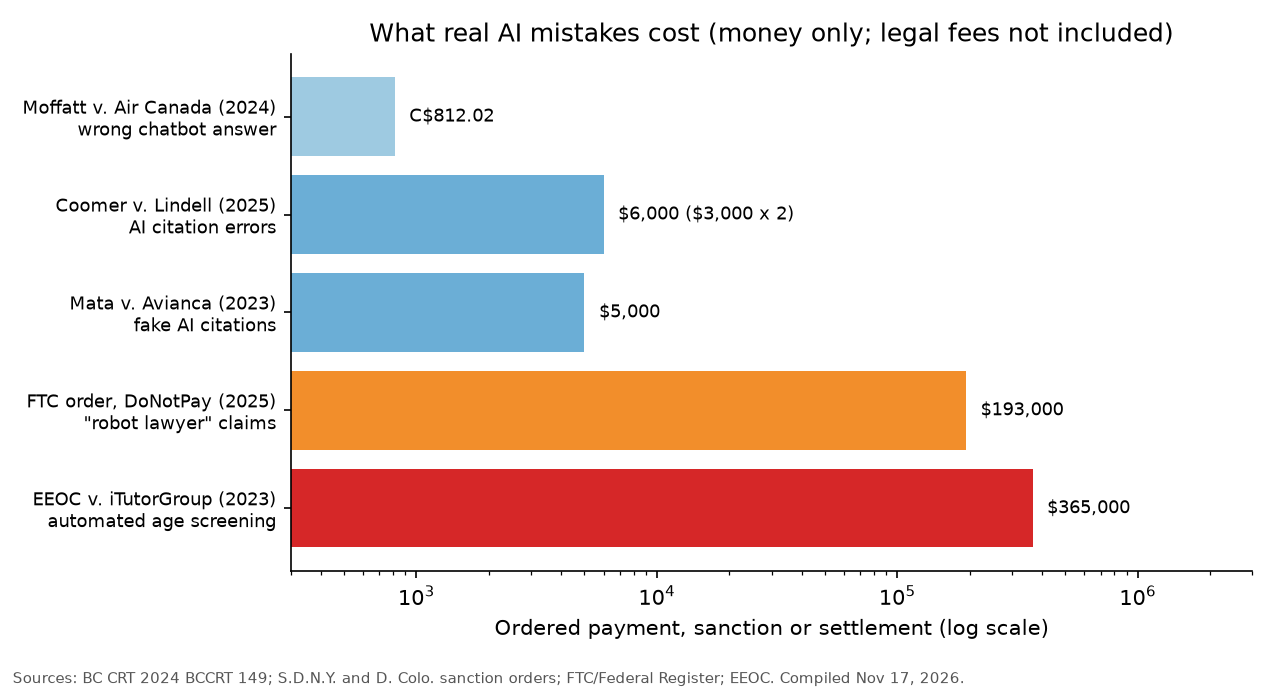 Ordered payments and settlements in documented AI mistake cases. Sources: the court, tribunal, EEOC and FTC records listed below. Compiled November 17, 2026.
What the comparison shows:
- The chatbot and citation cases were cheap in dollars (under $10,000) but expensive in other ways: public court records naming the people involved, and in Mata, letters to every judge falsely named as an author.
- The two largest amounts came from systematic choices, not one-off errors: software set up to reject older applicants, and marketing that claimed an AI could do a professional’s job. Both are decisions an owner makes on purpose.
- In the Air Canada case, the payment roughly equaled the fare difference (C$1,630.36 paid minus C$979.48 bereavement fare = C$650.88, plus interest and fees). In other words, the chatbot’s promise was enforced. Assume your bot’s promises will be too.
Tool: The 8-Question AI Risk Self-Audit
Answer yes or no for your business today. Each “yes” points to the mistake above with the same number.
1. Do we publish or send AI-written facts, prices or legal
   info without checking the original source?              Y / N
2. Does a chatbot or AI receptionist answer questions about
   refunds, pricing exceptions or warranties?               Y / N
3. Does any software reject job applicants, tenants or
   customers without a human looking first?                 Y / N
4. Do our ads claim AI makes results "perfect," "expert" or
   "guaranteed"?                                            Y / N
5. Have we ever used AI to write a review or testimonial?   Y / N
6. Do staff use free chatbots with customer or financial
   data, with no written rules?                             Y / N
7. Are we relying on copyright in an AI-generated logo
   or design?                                               Y / N
8. Do we send AI voice calls or automated texts without
   documented consent?                                      Y / N
How to read it: any “yes” on questions 3, 5 or 8 deserves attention this week, because they involve anti-discrimination law (the area behind the largest settlement in our table) or federal rules that allow per-violation penalties or damages (the FTC’s reviews rule and the TCPA). A “yes” on 1, 2 or 6 is the most common pattern for small businesses and the cheapest to fix: a review step, a narrower bot, and a one-page policy.
Your Guardrail Checklist
| Risk | Guardrail | Who owns it |
|---|---|---|
| Made-up facts | Verify against original sources before use | Whoever publishes or sends |
| Chatbot promises | Limit scope; route money/policy questions to humans; review logs weekly | Owner or manager |
| Automated people decisions | Human reviews every rejection; no protected-trait screening | Hiring manager |
| Marketing claims | Only claims you can prove | Owner |
| Reviews | Real customers only | Marketing lead |
| Sensitive data | Business plans; “never paste” list | Everyone |
| Outbound calls/texts | Documented consent; legal review | Owner |
If you’re just getting started, our 30-day getting-started plan builds these guardrails in from week one. For copy-ready prompts that ask the AI to flag uncertainty, see our AI prompts for small business owners.
Next Steps
- Take the 8-question self-audit above and write down every “yes.”
- Add one line to every AI prompt you use for facts: “Cite your sources and write [CHECK] where you’re unsure.” Then open the sources.
- Narrow your chatbot. List the topics it may answer and the ones it must hand to a person (refunds, warranties, legal, complaints).
- Read 10 chat logs or AI-drafted customer emails this week and note any errors.
- Rewrite any “AI-powered” marketing claim so it says what the tool actually does and who checks it.
- Write a one-page AI policy with a “never paste” list using our AI policy template.
Frequently Asked Questions
What are the biggest AI mistakes small business owners make?
Trusting AI answers without checking them, letting a chatbot make promises the business didn’t approve, automating decisions about people without human review, overclaiming what an AI product does, faking reviews, pasting sensitive data into public tools, assuming AI output is copyrightable, and running AI calls or texts without consent.
What is an AI hallucination?
It’s when an AI tool states something false as if it were true, such as an invented court case, statistic or policy. In Mata v. Avianca, ChatGPT produced fake case citations that lawyers filed in federal court.
Can my business be held responsible for what its chatbot says?
In the Air Canada case, a Canadian tribunal said yes: the company was responsible for all information on its website, including the chatbot. That small-claims decision doesn’t bind U.S. courts, but it’s safest to assume customers can rely on what your bot says.
Is it illegal to use AI in hiring?
No, but discrimination is illegal no matter what tool makes the decision. The EEOC’s iTutorGroup settlement involved software that automatically rejected older applicants.
Can I say my business is “AI-powered” in ads?
Yes, if it’s true and any claims about results are backed by evidence. The FTC’s DoNotPay order shows the risk of claiming an AI service performs like a professional.
How do I prevent AI mistakes without a big budget?
Keep a human on review for anything customer-facing or legal, limit what your chatbot can discuss, write a short AI policy, and verify facts against original sources.
Sources and Methodology
How we gathered the data: Every case comes from a primary record (court orders, the tribunal decision, agency releases and the Federal Register) or, for the NYC chatbot and Samsung, from the original investigative or news report. We re-read each record on November 17, 2026 and took dollar amounts exactly as stated. The case comparison table and chart are our compilation; amounts are in the currency of each record (Air Canada in Canadian dollars) and exclude legal fees and other costs. The self-audit is our tool, built so each question maps to one documented case or rule. This article is general information, not legal advice. No affiliate links.
- Mata v. Avianca, Inc., No. 1:22-cv-01461 (S.D.N.Y. June 22, 2023), Opinion and Order on Sanctions (Justia): https://law.justia.com/cases/federal/district-courts/new-york/nysdce/1:2022cv01461/575368/54/
- Coomer v. Lindell, No. 1:22-cv-01129 (D. Colo. July 7, 2025), Order (GovInfo): https://www.govinfo.gov/content/pkg/USCOURTS-cod-1_22-cv-01129/pdf/USCOURTS-cod-1_22-cv-01129-10.pdf
- The Markup – NYC’s AI Chatbot Tells Businesses to Break the Law (March 29, 2024): https://themarkup.org/artificial-intelligence/2024/03/29/nycs-ai-chatbot-tells-businesses-to-break-the-law
- The Markup – Malfunctioning NYC AI Chatbot Still Active (April 2, 2024): https://themarkup.org/artificial-intelligence/2024/04/02/malfunctioning-nyc-ai-chatbot-still-active-despite-widespread-evidence-its-encouraging-illegal-behavior
- Moffatt v. Air Canada, 2024 BCCRT 149 (Civil Resolution Tribunal): https://decisions.civilresolutionbc.ca/crt/crtd/en/525448/1/document.do
- EEOC – iTutorGroup to Pay $365,000 to Settle EEOC Discriminatory Hiring Suit: https://www.eeoc.gov/newsroom/itutorgroup-pay-365000-settle-eeoc-discriminatory-hiring-suit
- Federal Register – DoNotPay, Inc.; Analysis of Proposed Consent Order: https://www.federalregister.gov/documents/2024/09/30/2024-22400/donotpay-inc-analysis-of-proposed-consent-order-to-aid-public-comment
- The Verge – DoNotPay must pay $193,000 for “AI Lawyer” claims: https://www.theverge.com/news/610401/donotpay-cant-make-false-ai-lawyer-claims-says-ftc
- eCFR – 16 CFR Part 465, Use of Consumer Reviews and Testimonials: https://www.ecfr.gov/current/title-16/chapter-I/subchapter-D/part-465
- TechCrunch – Samsung bans use of generative AI tools after internal data leak: https://techcrunch.com/2023/05/02/samsung-bans-use-of-generative-ai-tools-like-chatgpt-after-april-internal-data-leak/
- Federal Register – Copyright Registration Guidance: Works Containing Material Generated by AI: https://www.federalregister.gov/documents/2023/03/16/2023-05321/copyright-registration-guidance-works-containing-material-generated-by-artificial-intelligence
- FCC – FCC Confirms that TCPA Applies to AI Technologies that Generate Human Voices: https://www.fcc.gov/document/fcc-confirms-tcpa-applies-ai-technologies-generate-human-voices