How Independent Insurance Agents Use AI in 2026: Data, Workflows and Guardrails
Last updated: November 17, 2026
How independent insurance agents use AI has changed fast. In 2025, a minority of agents used it at all. In 2026, most have tried it, but few agencies have a policy or an approved tool. Independent agencies live on renewals, referrals and response time. AI won’t replace a licensed agent’s judgment on coverage, but it can clear the admin pile that keeps you from calling clients back.
This guide pulls together the 2026 survey data, Census figures on agency size and AI use, a time-savings calculation, and the workflows and guardrails a small agency can adopt without a data-science hire. It’s general information, not E&O, compliance or legal advice. Confirm any tool against your state insurance department’s rules, your carrier agreements and your agency’s written procedures.
Key Takeaways
- Agents moved first; agencies lag. Liberty Mutual’s 2026 study found that 65% of independent agents used AI in the past year (up from 37% in 2025), but only 14% said their agency had implemented an AI tool and only 18% had a well-defined AI policy.
- Finance and insurance is one of the heaviest AI-using sectors. 39.2% of finance and insurance businesses used AI in the prior two weeks, vs. 24.2% of all U.S. businesses (Census BTOS, Oct 19–Nov 1, 2026).
- Most agencies are tiny. 72.3% of insurance agency and brokerage locations have fewer than 5 employees and 89.9% have fewer than 10 (Census CBP 2023). Small agencies need simple rules, not enterprise programs.
- The time payoff is real but self-reported. AI users in the Liberty Mutual study reported saving about 4 hours a week. At the median wage for insurance sales agents ($29.94/hour), even 1 hour a week is worth about $130 a month, several times the cost of a $20–$25 business seat.
- Keep a licensed human on coverage. Use AI for drafts, notes and checklists, never for binding or explaining coverage on a live risk.
How independent insurance agents use AI: the 2026 numbers
Two industry surveys this year give a consistent picture.
| Measure (2026) | Result | Source |
|---|---|---|
| Used AI for work at least a few times in the past year | 65% (37% in 2025) | Liberty Mutual / IA Magazine |
| Use AI weekly | 41% (18% in 2025) | Liberty Mutual / IA Magazine |
| Average time saved by AI users | ~4 hours/week; 14% save 8+ hours | Liberty Mutual / IA Magazine |
| Agency has implemented an AI tool | 14% | Liberty Mutual / IA Magazine |
| Agency has a well-defined AI policy | 18% (12% in 2025) | Liberty Mutual / IA Magazine |
| Agencies “just experimenting” / limited use / embedded / not using | 33% / 22% / 8% / 31% | Big “I” ACT Tech Trends 2026 |
| Plan to increase AI use in the next 12 months | About two-thirds | Big “I” ACT Tech Trends 2026 |
Sources: IA Magazine on the Liberty Mutual 2026 Independent Agency Growth Study (nearly 1,200 respondents); InsuranceNewsNet on the 2026 Big “I” ACT Tech Trends Report.
In the Liberty Mutual study, the biggest time savings came from meeting notes (44%), marketing content (43%), comparing policies (34%) and automating routine tasks (26%). The Big “I” report describes the same pattern: client emails, call summaries, marketing content and back-office review, usually through ChatGPT, Microsoft Copilot or AI features inside agency management systems.
Our read: the gap between 65% individual use and 14% agency implementation is the risk. It means most agents who use AI are probably doing it on their own accounts, with their own rules. That’s how client data ends up in a consumer chatbot.
How insurance compares with other industries
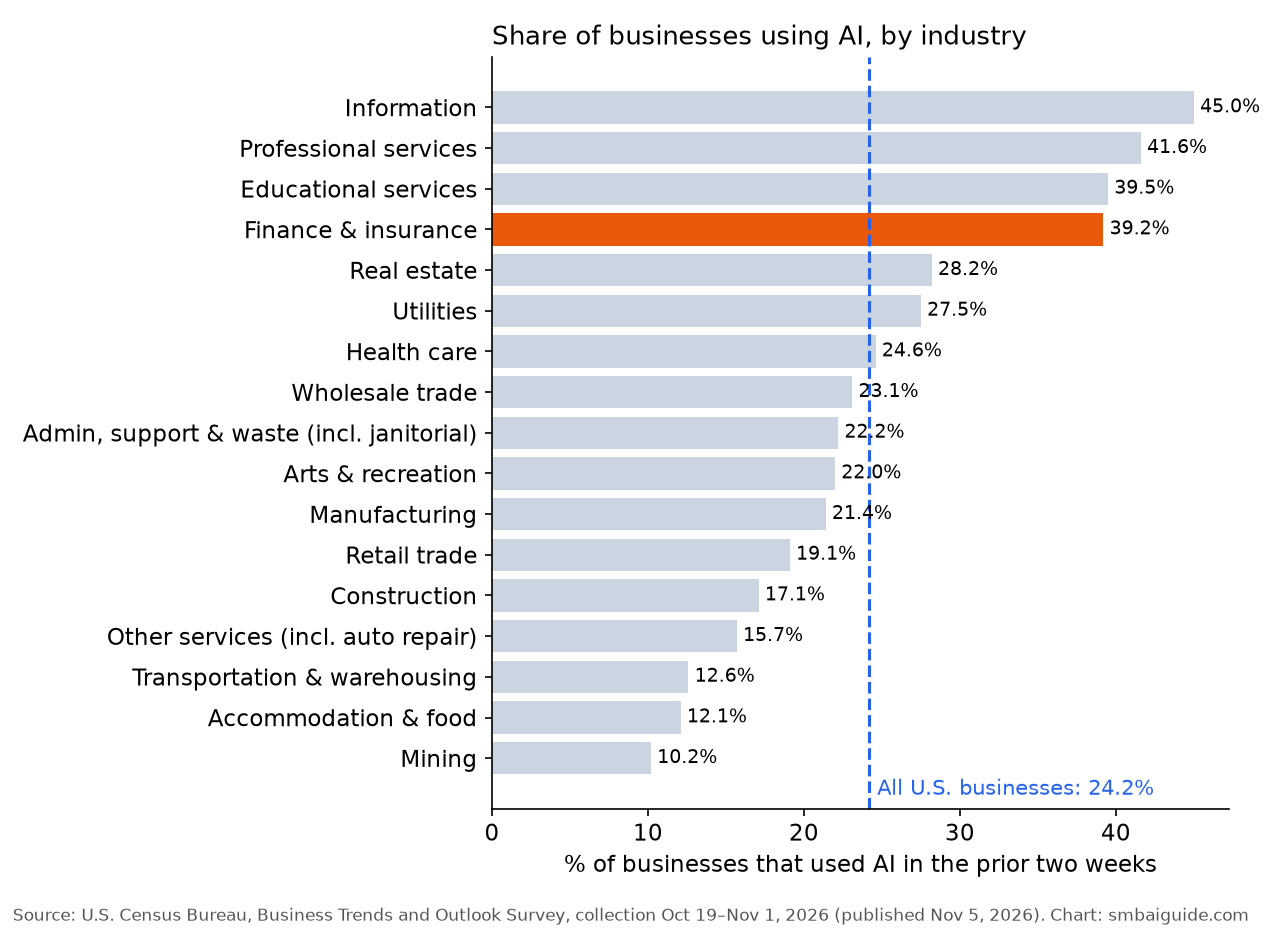
Source: U.S. Census Bureau, Business Trends and Outlook Survey, collection Oct 19–Nov 1, 2026 (published Nov 5, 2026). Chart: smbaiguide.com.
In the same survey, 41.4% of finance and insurance businesses said employees used generative AI for work tasks. Caveat: the Census sector includes banks, lenders and carriers as well as agencies, so treat it as a broad proxy, not an agency-only rate. Census doesn’t publish one for agencies alone.
Original analysis: what a typical agency looks like
We pulled the Census Bureau’s County Business Patterns (2023) for NAICS 524210, insurance agencies and brokerages.
| Employees per location | Locations | Share | Cumulative |
|---|---|---|---|
| Under 5 | 96,709 | 72.3% | 72.3% |
| 5–9 | 23,567 | 17.6% | 89.9% |
| 10–19 | 7,992 | 6.0% | 95.9% |
| 20–49 | 3,594 | 2.7% | 98.6% |
| 50 or more | 1,866 | 1.4% | 100% |
| Total | 133,728 |
Our calculation from Census CBP 2023 national file. Average: 818,561 employees ÷ 133,728 locations ≈ 6.1. CBP counts establishments (locations), not firms.
Why it matters: nine in ten agency locations have fewer than 10 people. The NAIC’s Insurance Data Security Model Law exempts licensees with fewer than 10 employees (including independent contractors) from its written information-security-program section, though not from its breach-investigation and notice duties (NAIC Model #668). State versions differ, and not every state has adopted it (NAIC state page). Being exempt from one section doesn’t make it safe to paste client files into a free chatbot.
Tool: what AI time savings are worth to an agency
Using the BLS median wage for insurance sales agents ($29.94 an hour, May 2025) and 4.33 weeks per month:
| Hours saved per agent per week | Monthly value per agent | Annual value per agent |
|---|---|---|
| 1 (conservative) | $130 | $1,556 |
| 2 | $259 | $3,111 |
| 4 (Liberty Mutual users’ average) | $519 | $6,223 |
Compare that with a business AI seat at $20–$25 a month (for example, ChatGPT Business at $20/seat/month billed annually, two-seat minimum; ChatGPT pricing). Assumptions: time savings are self-reported in the survey and count only if the freed time goes to selling or service; review time must be subtracted. Use your own 30-day measurements before scaling.
Five workflows that stay in your control
1) New-lead intake summaries. Paste a lead form (with identifiers removed) into an approved assistant and ask for the lines of coverage requested, the missing underwriting facts (vehicles, drivers, year built, prior claims) and three clarifying questions for the callback. Keep Social Security numbers and financial data out of any tool that isn’t under contract.
2) Renewal and remarketing checklists. Turn your renewal checklist into a client email: documents still needed, what changed since last year, and the deadline. You still verify carrier appetite and pricing yourself.
3) Meeting and call notes. Use an approved notetaker to draft topics, open items, documents promised and follow-up dates. An agent edits the note before it goes into the agency management system. This was the top time-saver in the Liberty Mutual data.
4) Certificate chase emails. AI can draft polite follow-ups for missing certificate-holder information. It must not invent coverage language. Certificates still follow carrier and agency rules.
5) Training new CSRs on “what we never say.” Turn your banned phrases and E&O reminders into a short quiz or role play.
Prompts that stay useful (and safer)
- “Turn these CSR bullet points into a polite renewal-document request email. Do not add coverage advice.”
- “List the missing facts for a personal-auto quote from this intake text. Flag anything that looks like a full SSN and tell me to remove it.”
- “Summarize this meeting transcript into open items, owners and due dates. Do not invent commitments.”
A bad prompt looks like “Does my client’s homeowners policy cover flood in Texas?” when the model has no policy in front of it. That’s how hallucinated advice starts.
Guardrails: privacy, E&O and state AI rules
- Business accounts only. Use business tiers with admin controls, not personal ChatGPT or Gemini logins.
- A one-page AI policy. Only 18% of agencies have a well-defined one. Use our AI policy template and privacy guide.
- No sensitive data in consumer tools: full applications, medical details, driver’s license numbers or payment data.
- Keep a list of approved workflows. If a carrier or your E&O insurer asks how you use AI, you should have an answer.
- Verify everything. AI can make up policy forms, endorsements and statute numbers. Check carrier documents and your state insurance department.
State AI rules. The NAIC’s model bulletin on insurers’ use of AI systems had been adopted by 30 jurisdictions (28 states plus D.C. and Puerto Rico) as of November 13, 2026, and California, Colorado and New York have their own insurance-specific guidance (NAIC adoption map). The bulletin is aimed at insurers, but carriers may push expectations down to appointed agencies through agreements and vendor reviews. Expect questions about the AI you use when you handle their customers’ data.
A 14-day pilot
- Days 1–2: Pick one workflow (meeting notes or renewal emails) and write the data rules.
- Days 3–5: Run it on five past, non-sensitive examples and compare with what a senior CSR would send.
- Days 6–10: Use it live, with a person reviewing every message.
- Days 11–14: Measure minutes saved per file and corrections needed, then keep, revise or drop it.
Track for 30 days: time from lead to first real callback, drafting minutes per CSR per day, drafts needing factual correction, and any near-miss where client data almost entered a consumer tool.
If a vendor pitches “insurance AI”
Ask for:
- a written data-processing description and retention period
- whether your data trains shared models
- audit logs and single sign-on
- how it handles ACORD forms, certificates and your agency management system
- references from agencies your size
Many agencies get further with AI features already in their management system or email suite plus a business chatbot seat than with a vague “AI platform.” See our guides to AI email assistants and AI meeting notes.
Next steps
- Ask your team which AI tools they already use for agency work, without blame.
- Choose one approved business tool and turn on its admin and data settings.
- Write a one-page AI rule covering banned data, approved uses and the licensed-review requirement.
- Run the 14-day pilot on meeting notes or renewal emails.
- Put your measured hours into the calculator above, and decide whether to expand.
Frequently asked questions
Will AI replace independent agents?
Not for licensed advice, carrier negotiation or relationships. It replaces blank-page drafting and some sorting. Both 2026 surveys describe agencies using AI to support the advisor role, not replace it.
Can I use ChatGPT for client emails?
Only under a process your agency approves, with identifiers removed or a business plan with appropriate data terms, and a person reviewing every message.
Does AI help with quoting accuracy?
It can organize inputs and flag missing facts. It doesn’t replace underwriting rules or carrier rating engines.
Do state AI rules apply to my agency?
The NAIC model bulletin applies to insurers. Your state’s privacy, data-security and unfair-practices rules apply to you as a licensee, and carriers may add AI requirements by contract. Check with your state department and your carriers.
What should I tell clients?
Be honest that you use AI for admin speed, and that a licensed person stands behind every recommendation.
Where should a one-person agency start?
Meeting notes and renewal reminder drafts. They free the most time with the least coverage risk.
Sources and methodology
How we did this: Survey results come from published summaries of Liberty Mutual’s 2026 Independent Agency Growth Study (IA Magazine, August 2026) and the 2026 Big “I” ACT Tech Trends Report (InsuranceNewsNet, March 2026). Sector AI-use rates come from the Census Bureau’s Business Trends and Outlook Survey, sector file, collection Oct 19–Nov 1, 2026. Agency size figures are our calculations from the Census County Business Patterns 2023 national file (NAICS 524210). Wages are BLS OEWS May 2025 medians. The time-value table is our arithmetic (hours × 4.33 × $29.94) and isn’t a measured result. Regulatory documents were checked November 17, 2026. This is not legal or compliance advice.
- IA Magazine, “Agents Using AI Save 4 Hours a Week, Says Liberty Mutual Study”: https://www.iamagazine.com/news/agents-using-ai-save-4-hours-a-week-says-liberty-mutual-study/
- InsuranceNewsNet, “Two-thirds of independent agencies plan to increase AI use this year”: https://insurancenewsnet.com/innarticle/two-thirds-of-independent-agencies-plan-to-increase-ai-use-this-year
- U.S. Census Bureau, Business Trends and Outlook Survey: https://www.census.gov/hfp/btos/data_downloads
- U.S. Census Bureau, County Business Patterns: https://www.census.gov/programs-surveys/cbp.html
- U.S. Bureau of Labor Statistics, Occupational Employment and Wage Statistics tables: https://www.bls.gov/oes/tables.htm
- NAIC, Insurance Data Security Model Law (#668): https://content.naic.org/sites/default/files/model-law-668.pdf
- NAIC, Insurance Data Security Model Law state page: https://content.naic.org/sites/default/files/model-law-state-page-668.pdf
- NAIC, AI Model Bulletin adoption map: https://content.naic.org/sites/default/files/legal-adoption-map-ai-model-bulletin.pdf
- ChatGPT pricing: https://chatgpt.com/pricing
General information only. This is not legal, compliance or E&O advice. Rules vary by state and carrier, so confirm with your state insurance department, your carriers and qualified counsel.